Saturday, November 15, 2014

U Md "Psychologist of Morality" C.Fred Alford: re Whistling girls and crowing hens

Whistling girls and crowing hens
Always come to some bad ends.

Dr. J.Fred Alford is a political scientist who describes himself as a "moral psychologist." He is a professor of political philosophy at the University of Maryland. 

Review 1 with quotes from Alford's book, Whistleblowers: Broken Lives and Organizational Power
"To be a whistleblower," writes C. Fred Alford, "is to step outside the Great Chain of Being, to join not just another religion, but another world. Sometimes this other world is called the margins of society, but to the whistleblower it feels like outer space."
Alford paints a picture of the way organizations behave when confronted by an outspoken member who has observed organizational misconduct—and the rationalizations of its members who remain silent. The picture he paints is sobering, even troubling.

Alford is sceptical of the heroic accounts in which the courageous employee brings a corrupt organisation to account, benefiting society and receiving society’s gratitude. Instead, he has a much darker, more pessimistic message. Nearly all whistleblowers are destroyed. They lose their jobs, their careers, their houses, their friends, their families. But that is not the worst part. Most catastrophically, whistleblowers lose their trust in people and justice. 
For whistleblowers, the book has passages that will be illuminating but also agonising. In telling their stories, over and over, whistleblowers typically go through a sequence of events. This, Alford thinks, serves as a substitute for telling a story that has an ending and a real meaning. The problem is that whistleblowers don’t want to recognise the underlying truth, which is that there is no justice in the world and that organisations operate on the basis of power, not morality. If they recognise this truth, then their own actions become pointless. What is the use of behaving morally in a world without justice? Even when whistleblowers are later vindicated, it doesn’t really help. As Alford asks, "What is the satisfaction in being right if as a consequence one has to give up everything one believed in?" (p. 51).
When whistleblowers lose their trust in people and organisations, they enter a new sphere of meaning, or perhaps lack of meaning. "For some, the earth moves when they discover that people in authority routinely lie and that those who work for them routinely cover up. Once one knows this, or rather once one feels this knowledge in one’s bones, one lives in a new world. Some people remain aliens in the new world forever. Maybe they like it that way. Maybe they don’t have a choice." (p. 52).
Alford says that "The whistleblower is a political actor in a nonpolitical world." (p. 97). By this he means that the whistleblower acts on the basis of values within an organisation where values have no role. Within the organisation, the main rule is to do what the boss wants. Anyone who imports values into the organisation from the outside, such as public safety, fairness or honesty, is a threat to the line of command and must be expelled.
Because of the unremitting hostility of bosses to whistleblowers, laws do little to help, since ways are easily found of getting around them. In th US, there are hundreds of laws protecting whistleblowers, but they are little help. "At a conference on the legal protection of whistleblowers, every lawyer who spoke agreed that the laws do not work very well and that new laws rarely help." (p. 108). Organisations have much more money and much more time: $100,000 and ten years to run a case is commonplace. Alford says that the law makes the "autonomous ethical individual" expendable (p. 113).

Friday, November 14, 2014

Julian Assange and the grey area of govt-corp action; connected cars; lawyers

The grey area is HERE.

As I also chronicled recently, Julian Assange recently wrote up and published a trascript of his 2011 conversation with Google executives. He is writing more about it now with some insights that go right through the fog. 

[Google exec] Cohen’s directorate appeared to cross over from public relations and “corporate responsibility” work into active corporate intervention in foreign affairs at a level that is normally reserved for states. Jared Cohen could be wryly named Google’s “director of regime change.”
This is relevant to me because Assange's identification of the core of the government-corporate nexus (the grey area) and his exposure of the true goings-on inside that nexus suggests that the same dynamic may well apply (albeit to a lesser extent) to other powerful corporations. Maybe, just maybe, it may apply to Toyota and perhaps other automakers. Google's control of the world of information has grown in tandem with globe-spanning automaker dominance in the world of tangible things, and I now realize, duh, maybe I am late, but I can now see that not only some of Google's power, but also the power of major industrial companies, derives from their high level service to the government. I had presumed that their control of govenment was merely because they provided jobs and tax revenues, and had the money to ply candidates and lobbyists. Now, with Assange's light, I can see how a literally bankrupt organization like the US government is bending to the will of corporations because it needs them to implement its domestic and foriegn policies when it can no longer effectively do so for itself. 

There is much to do in the grey areas of favors, backroom connections, bedtime stories, surveillance, and general chumminess that automakers have to offer the foreign policy guys, the NSA, the CIA, and even the FBI. And just think of how much more valuable that will become when connected cars can dump endless petabytes of location data into the NSA's databases, for one obvious example. It hits me! The pending connected cars as the nucleus of the Internet of things makes automakers the newest darlings of the dark-matter beings within the US government. Google's famous driverless car is a Toyota, remember. And on an even simpler level, the fancy Toyota SUV makes the most perfect gift, the very best gift, to anyone. That is very very simple, and it works in all kinds of countries. (Yes, dear, I sound like a conspiracy theorist..you can go ahead, FTI, tell your bosses. Your performance yesterday was quite remarkable. I should set a stopwatch next time.)


Where do the lawyers fit in? That grey area is their comfortable home, because they form a vast network of people whose conversations (and conversations with their contractors) can never be discovered except in the most egregious criminal situations, and that perhaps is limited to those petty criminals that are the DOJ fodder, meant only for self-congratulatory PR and to attempt to wow the public into thinking it is actually being protected from the bad guys. 

Meanwhile, the corporate inside counsel and defense counsel are forever free to make any arrangements, have any discussions, and protect any amount of illicit complicity between the government and their clients. The public will never know what they say. Meanwhile, when things go wrong for consumers in this cozy setup where government can't tell corps what to do, the shake-down specialist plaintiffs who work in unspoken symbiosis with their opponents step in and take their share of the money pie in exchange for shutting up about the illegal dealings that they witness among their opponents who are really their paymasters. They are the only witnesses and they shut up about it. So they are part of the problem. I don't blame them entirely. But I see that the situation for them is that they are symbiotic.

Symbiosis.

To be continued, I hope, another day.

Thursday, November 13, 2014

Underappreciated risk in auto electronics safety: counterfeit parts


Such shiny watches!

I think that automakers must all have built advanced systems to detect counterfeit electronic components and electrical parts. But maybe not. You cannot be too careful. You have to test continuously, according to CALCE chief Dr. Michael Pecht.

And consumers do not have testing labs, do they? They must trust the automakers and parts suppliers.

CALCE has made a name for itself in holding these anti-counterfeiting seminars for years already. There must be a reason that they are needed.

Dr. Diganta Das of CALCE, University of Maryland will teach a full day Master Class “Counterfeit Electronics Components: Avoidance and Detection” on at the 24th MIRCE International Symposium at Exeter, England, United Kingdom on December 4, 2014. The course will draw upon the practical experience of Dr. Das on the area of counterfeit part through his work with government, industry, academia, law enforcement, test laboratories, electronic part users, distributors and manufacturers.

For more information on the course click here.

cid:part2.05010308.08060205@calce.umd.eduDr. Diganta Das, Science Fellow of the Mirce Akademy, is a member of the research staff at the Center for Advanced Life Cycle Engineering. Dr. Das is the organizer of the most trusted event in fighting counterfeit electronics in the United States and with SMTA he had organized 10 conferences with large participation of industry, government, law enforcement, test laboratories and standards development organizations. He is a group leader for the SAE G-19 counterfeit detection standards group and has leading role in developing the standards. He has organized sessions in SAE’s Aerospace Conference on counterfeit electronics.  He has developed and taught courses on counterfeit electronics and helped develop training material related to counterfeit electronics. He is the recipient of member of technical distinction award of SMTA for 2014 for his effort on counterfeit electronics prevention. 

For more information on the class, please contact Dr. Diganta Das. To register for the class, please download the registration form athttp://www.mirceakademy.com/uploads/2014-Master%20Clas-%20Counterfeit_.pdf

You can also use the attached registration form and mail the completed form to complete registration. 

  
The topics covered will include:
History of counterfeit electronic components

Electronic Part Supply Chain
·         Assessment of Electronic Part Manufacturers and Parts
·         Assessment of Electronic Part Distributors
How to Assess and Utilize Process Change Notices
  • Introduction and examples
  • Use in counterfeit detection

Counterfeit part related prosecutions – two case studies

SAE Counterfeit Related Standards

Use of Authentication Tools and Taggants
  • DNA Based
  • Ceramic Based
  • Polymer Based
  • Creating a Supply Chain and Logistics Network for Taggants

Counterfeit part detection techniques
  • Non-destructive (optical, External Visual Inspection)
  • Non-destructive (X-ray, XRF)
  • Materials Characterization Techniques (FT-IR, DSC, TMA)
  • Electrical Characterization
  • Destructive techniques
  • How to effectively engage a test lab to perform counterfeit detection testing
The Future Directions

Please direct questions to Dr. Diganta Das.

Ralph Nader and Clarence Ditlow: Regulators "asleep," NHTSA needs "complete overhaul"

Regulatory sleep disorder.

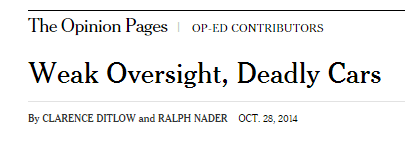
Ralph Nader and his protege, Clarence Ditlow of the Center for Auto Safety, have taken up their pens and have finally written, strongly, what needs to be said in the nation's newspaper of record. And this was two weeks ago, even before the most damning revelations of the urgent but secret ignition switch order for 500,000 pieces to Delphi from GM (and GM's failure to produce the documents about that order) and the story of the Takata whistleblowers who claim that their secret airbag tests were covered up by Takata management. These are perfect cases in point, and Nader and Ditlow should be awarded medals of honor and LOTS of CASH for their tenacity in fighting for auto safety for decades while the government slept and automakers made money at the expense of the public. They are doing the giant job that the ENTIRE U.S. GOVERNMENT HAS DROPPED. The problem goes way beyond NHTSA. The problem extends to Congress and the DOJ as well. Maybe also to the courts that approve secret settlements. And maybe also to citizens who do not take any action either. Whoever is to blame. the public is now finally aware that it is at risk. That is a good thing, and thanks in great part to these brave, persistent, nay, heroic two gentlemen.


.......

My contempt hearing postponed one week


Clock.

I do not plan to attend this hearing in person, but maybe by telephone. I look forward to it.

Activity in Case 8:10-ml-02151-JVS-FMO In re: Toyota Motor Corp. Unintended Acceleration Marketing, Sales Practices, and Products Liability Litigation Text Only Scheduling Notice

From: cacd_ecfmail@cacd.uscourts.gov [mailto:cacd_ecfmail@cacd.uscourts.gov]
Sent: Thursday, November 13, 2014 9:17 AM
To: ecfnef@cacd.uscourts.gov
Subject: Activity in Case 8:10-ml-02151-JVS-FMO In re: Toyota Motor Corp. Unintended Acceleration Marketing, Sales Practices, and Products Liability Litigation Text Only Scheduling Notice

This is an automatic e-mail message generated by the CM/ECF system. Please DO NOT RESPOND to this e-mail because the mail box is unattended. 
UNITED STATES DISTRICT COURT for the CENTRAL DISTRICT OF CALIFORNIA
Notice of Electronic Filing

The following transaction was entered on 11/13/2014 at 9:15 AM PST and filed on 11/13/2014
Case Name:
In re: Toyota Motor Corp. Unintended Acceleration Marketing, Sales Practices, and Products Liability Litigation
Case Number:
Filer:
Document Number:
4768(No document attached)
Docket Text:
(IN CHAMBERS) The Court, on its own motion and with the agreement of counsel, CONTINUES the hearing on the Order to Show Cause re: Why Civil Sanctions Should Not Issue Against Betsy Benjaminson [4664],[4668],[4663], previously scheduled for 11/17/14 at 3:00 PM, to MONDAY, 11/24/2014 at 8:00 AM before Judge James V. Selna. THERE IS NO PDF DOCUMENT ASSOCIATED WITH THIS ENTRY. (kt) TEXT ONLY ENTRY

8:10-ml-02151-JVS-FMO Notice has been electronically mailed to: [around 1000 attorneys]


In India, Toyota directors escape criminal trial for confirmed airbag defect; complaint alleges fraud and criminal conspiracy

SC quashes criminal trial of Toyota Motor directors

The apex court ruling comes on the plea challenging the Allahabad HC order
עו"ד? הופע במפות Google
הופע על המפה ובחיפוש ב-Google.   הירשם ל-Google My Business בחינם. www.google.co.il/business
Ads by Google
RELATED NEWS
אזרח אמריקאי? אתה חייב
חייב לדווח לרשויות המס האמריקאיות   ולהימנע מסנקציות מיותרות, לפרטים!www.ustax.co.il
Stainless Steel Pipes
Chenbros-Supplier of stainless   steel tube, stainless steel pipes.www.chenbros.com.tw
Ads by Google
The today quashed the order allowing the criminal trial of directors of on a complaint of a buyer that the of the was defective which caused his driver’s death and injury to him.

Toyota offered to pay Rs 15 lakh to the family of the driver who died and Rs 10 lakh to the owner of the vehicle. Disposing of the appeal, the bench headed by Chief Justice H L Dattu stated that this order would not be a precedent to be cited in other cases.

Gautam Sharma, the vehicle owner, filed a complaint against all the directors of the company, without the company being named, for cheating, forgery and criminal conspiracy.

The non-deployment of the airbags had allegedly led to the death of his driver and injuries to him in the accident in 2012. Since there was no direct collision, the airbags did not inflate, it is said.

The four directors moved the high court for quashing the complaint as they were not directly responsible for the accident, but it refused to do so as the trial court had already taken cognizance of the complaint.

Therefore the directors, C Kirloskar, Vikram S Kirloskar, Shekar Vishwanathan and Sandeep Singh, moved the Supreme Court.

When the appeal was mentioned before the Chief Justice yesterday, the bench had asked the company to arrive at a settlement with the affected parties. Senior counsel F S Nariman had agreed to do so. The offer to pay the compensation was made following this assurance.

The court had also observed on Wednesday that the directors could not be vicariously made liable in a criminal complaint unless their specific role is evident. The principle of vicarious liability is found only in the law of torts.

Wednesday, November 12, 2014

Matt Taibbi on Holder's sweet deal with Chase, while whistleblower Alayne Fleischmann gets nowhere

Eric Holder cuts a sweet deal with Chase's Jamie Dimon, even bypassing federal judges, 
while insider attorney Alayne Fleischmann peeps out 
of her whistleblower strongbox window in dismay.

This Rolling Stone article tells the story of the Chase insider who watched in horror as Holder helped Chase cover up its crimes. Eventually her name emerged, and Matt writes her story. As a much smaller kind of whistleblower, I can relate to her frustration and disillusionment as she watched the DOJ--that I thought was the last bastion of justice remaining in the US government-- cave in to corporate interests.

"I thought, 'I swear, Eric Holder is gas-lighting me,' " she says.
Ask her where the crime was, and Fleischmann will point out exactly how her bosses at JPMorgan Chase committed criminal fraud: It's right there in the documents...
She believes the proof is easily there for all the elements of the crime as defined by federal law – the bank made material misrepresentations, it made material omissions, and it did so willfully and with specific intent, consciously ignoring warnings from inside the firm and out.
She'd like to see something done about it, emphasizing that there still is time. The statute of limitations for wire fraud, for instance, has not run out, and she strongly believes there's a case there, against the bank's executives. She has no financial interest in any of this, no motive other than wanting the truth out. But more than anything, she wants it to be over.
In today's America, someone like Fleischmann – an honest person caught for a little while in the wrong place at the wrong time – has to be willing to live through an epic ordeal just to get to the point of being able to open her mouth and tell a truth or two. And when she finally gets there, she still has to risk everything to take that last step. "The assumption they make is that I won't blow up my life to do it," Fleischmann says. "But they're wrong about that."Good for her, and great for her that it's finally out. But the big-picture ending still stings. She hopes otherwise, but the likely final verdict is a Pyrrhic victory."
Read more: http://www.rollingstone.com/politics/news/the-9-billion-witness-20141106#ixzz3Is8WoHfg

And Alayne and Matt are now doing the cool-media rounds. They are so good-looking, and this is their moment in the spotlight, but they still are still outsiders to the power structure.

In an MSNBC interview quoted in Salon, Alayne said: “That’s the key point with these settlements,” she said. “They make it look like they’re hard cases but they’re not. … There are emails. There are reports that were ignored. There are vendor reports that were ignored. There are emails from diligence managers, from myself. There’s a letter that sets out exactly who did what and what’s wrong in our diligence process and how that’s going to cause problems in the security....

...I think part of the problem is [Chase execs] know they can bring in their lawyers and their PR and their lobbyists and make it go away. So as long as they know they can do that, why would they stop?”

[sounds SOOO FAMILIAR] Oh Richard! Soooo familiar!

Question:  "Just where do we see equality before the law in this latest new-0ld story?"

Remember: Today in history: Pearl Harbor General Tojo sentenced to death


Unrepentant:
Japanese Prime Minister Shintaro Abe bowing at Yasukuni Shrine that enshrines the memory of Japan's war criminals,
including Tojo, whose was sentenced to death for war crimes on November 12, 1948, 
and subsequently hanged. 
Abe is responsible for Japan's recent passage of the State Secrets Act.
Japan
     Sep 8, 2005
http://imagen01.247realmedia.com/RealMedia/ads/Creatives/default/empty.gif
http://www.atimes.com/images/f_images/spacer15.gif

http://www.atimes.com/images/f_images/spacer15.gif
Yasukuni's Class A war criminals 

The post-World War II International Military Tribunal for the Far East distinguished three types of war crimes: crimes against peace, conventional war crimes, and crimes against humanity, referred to as Class A, B and C, respectively. 

More than 300,000 Japanese were charged with Class B and C war crimes, mostly over prisoner abuse. Twenty-five military and political leaders were convicted of waging war - a Class A crime against peace - and 12 of those, including wartime prime minister Hideki Tojo and six others sentenced to death by the tribunal, are enshrined at Yasukuni. Two others, also enshrined at Yasukuni, were charged with Class A crimes but died before their trials were completed.

 The Class A indictment accused the defendants of promoting a scheme of conquest that "contemplated and carried out ... murdering, maiming and ill-treating prisoners of war [and] civilian internees ... forcing them to labor under inhumane conditions ... plundering public and private property, wantonly destroying cities, towns and villages beyond any justification of military necessity; [perpetrating] mass murder, rape, pillage, brigandage, torture and other barbaric cruelties upon the helpless civilian population of the overrun countries". 

The counts of indictment were:

·  Count 1: As "leaders, organizers, instigators, or accomplices in the formulation or execution of a common plan or conspiracy .. to wage wars of aggression, and war or wars in violation of international law".
·  Count 27: Waging unprovoked war against China;
·  Count 29: Waging aggressive war against the United States;
·  Count 31: Waging aggressive war against the British Commonwealth;
·  Count 32: Waging aggressive war against the Netherlands;
·  Count 33: Waging aggressive war against France (Indochina);
·  Count 35 & 36: Waging aggressive war against the USSR;
·  Count 54: "Ordered, authorized, and permitted" inhumane treatment of prisoners of war and others;
·  Count 55: "Deliberately and recklessly disregarded their duty" to take adequate steps to prevent atrocities.

The Class A war criminals enshrined at Yasukuni are:

(Sentenced to death)

·  Tojo, General Hideki (1884-1948). Chief, Manchurian secret police, 1935; councillor, Manchurian Affairs Bureau, 1936; chief of staff, Kwantung Army, 1937-38; vice minister of war, 1938; minister of war 1940-44; premier, 1941-44. Considered the arch-criminal of the Pacific War. Tojo assumed full responsibility for all the actions of his government and the military during the war. Convicted on Counts 1, 27, 29, 31, 32, 33, 54.

·  Doihara, General Kenji (1883-1948). Commander, Kwantung Army, 1938-40; Supreme War Council, 1940-43; army commander in Singapore, 1944-45. Deeply involved in the army's drug trafficking in Manchuria. Later ran brutal POW and internee camps in Malaya, Sumatra, Java and Borneo. Convicted on counts 1, 27, 29, 31, 32, 35, 36, 54.

·  Hirota, Baron Koki (1878-1948). Ambassador to the Soviet Union, 1928-31; foreign minister, 1933-36; premier, 1936-37. Was foreign minister during the Rape of Nanjing and other atrocities perpetrated by the army. As premier, he led his cabinet in planning the invasions of Southeast Asia and the Pacific islands, in addition to continuing the undeclared war against China. Convicted on Counts 1, 27, 55.

·  Itagaki, General Seishiro (1885-1948). Chief of Staff, Kwantung Army, 1936-37; minister of war, 1938-39; chief, army general staff, 1939; commander in Korea, 1941; Supreme War Council, 1943; commander in Singapore, 1945. Troops under his command in China terrorized prisoners and civilians. Was responsible for prison camps in Java, Sumatra, Malaya, Borneo and elsewhere. Convicted on Counts 1, 27, 29, 31, 32, 35, 36, 54.

·  Kimura, General Heitaro (1888-1948). Chief of Staff, Kwantung Army, 1940-41; vice minister of war, 1941-43; Supreme War Council, 1943; army commander in Burma, 1944-45. Helped plan the China and Pacific wars, including surprise attacks. Involved in the brutalization of the Allied POWs and was the field commander in Burma when civilian and POW slave labor built and died on the Siam-Burma Railway. Convicted on Counts 1, 27, 29, 31, 32, 54, 55.

·  Matsui, General Iwane (1878-1948). Personal appointee of the emperor to the Geneva Disarmament Conference, 1932-37; commander, China Expeditionary Force, 1937-38. Troops under his overall command were responsible for the Rape of Nanjing in 1937 and other atrocities. He retired in 1938 and then ceased to play an active role in military affairs. Convicted on Count 55.

·  Muto, General Akira (1892-1948). Vice chief of staff, China Expeditionary Force, 1937; director, military Affairs Bureau, 1939-42; army commander in Sumatra, 1942-43; army chief of staff in the Philippines, 1944-45. Troops under his command participated in both the Rape of Nanjing and the Rape of Manila. Convicted on Counts 1, 27, 29, 31, 32, 54, 55.

(Sentenced to life imprisonment)

·  Hiranuma, Baron Kiichiro (1867-1952). Privy Council, 1924-39; founder and president of Kokuhonsha (a right-wing patriotic society), 1926-28; premier, 1938; minister of home affairs, 1940; minister without portfolio, 1940-41; president, Privy Council, 1945. Convicted on Counts 1, 27, 29, 31, 32, 36.

·  Koiso, General Kuniaki (1880-1950). Vice minister of war, 1932; Chief of Staff, Kwantung Army, 1932-34; army commander in Korea, 1935-38; minister of overseas affairs, 1939; governor-general, Korea, 1942-44; premier 1944-45. Was known among the Korean population as "the Tiger of Korea" because of his brutality. As premier, he was aware of POW death camps. Convicted on Counts 1, 27, 29, 31, 32, 55.

·  Shiratori, Toshio (1887-1949). Director, Information Bureau, Foreign Ministry, 1929-33; ambassador to Italy, 1938-40; adviser to the foreign minister, 1940. A supporter of military expansionism, he favored an alliance among Germany, Italy the Soviet Union and Japan to dominate the world. Convicted on Count 1.

·  Umezu, General Yoshijiro (1882-1949). Section chief, general staff, 1931-34; commander, China Expeditionary Force, 1934; vice minister of war, 1939-44; army chief of staff, 1944-45. Convicted on Counts 1, 27, 29, 31, 32.

(Sentenced to a lesser term)

·  Togo, General Hideki (1884-1948). Ambassador to Germany, 1937; ambassador to the Soviet Union, 1938; foreign minister, 1941-42, 1945. Convicted on Counts 1, 27, 29, 31, 32. Sentenced to 20 years in prison.

(Died before their trials were completed)

·  Matsuoka, Yosuke (1880 - 1946). Gained international notoriety in 1933 when he announced Japan's departure from the League of Nations as a result of the League's criticism of Japan's operations in "Manchu State". After leaving the foreign service, he became president of the South Manchurian Railroad, at which time he worked closely with Hideki Tojo, who was then serving as chief of the Kwantung Army's secret police. In 1940, Matsuoka became minister of foreign affairs under prime minister Konoe Fumimaro. Matsuoka was a major advocate of a Japanese alliance with Nazi Germany and fascist Italy.

·  Nagano, Osami (1880 -1947). Appointed minister of the navy under Koki Hirota in 1936, and was appointed Commander in Chief of the Fleet in 1937. In 1941, Nagano became Chief of the Naval General Staff. In this capacity, he ordered the attack against the United States Pacific Fleet in Pearl Harbor. He was promoted to fleet admiral in 1943. While standing trial he assumed responsibility for the Pearl Harbor attack, but he died of a heart attack before the trial was complete. 


Wherefore Abe.